A field guide to Begonia maculata — light, water, humidity, substrate, and what those polka dots are actually for.
About the Cultivar
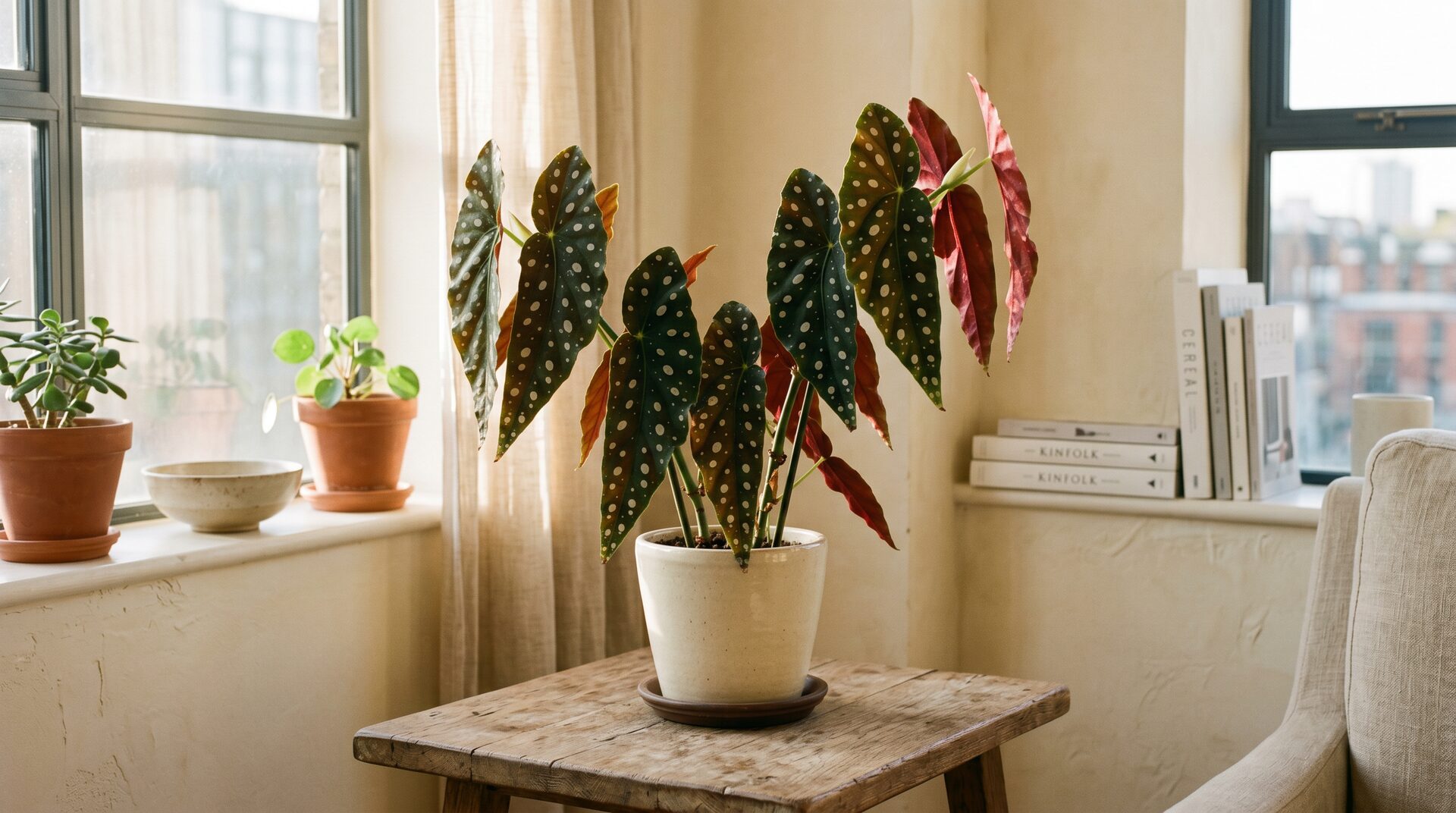
Maculata is the standout. Olive-green leaves with silver polka dots on top, deep burgundy underneath. Fast growth, easy flowers, and she sprawls if you let her.
If Frydek is moody, Maculata is the social plant. Forgiving until she isn't. Wet soil or stagnant humidity, and she punishes fast. Get those two right and the rest clicks into place.
Here's what Begonia maculata needs to keep showing off.
Native Range and Form
Begonia maculata is a cane-type begonia native to the Atlantic coastal rainforest of southeastern Brazil — Rio de Janeiro and Espírito Santo (POWO, Royal Botanic Gardens Kew). You'll see it sold as polka-dot begonia or angel wing begonia. Both names land the moment you see a mature leaf: asymmetrical wings, olive-green on top with scattered silver spots, blood-red underneath.
It grows upright on cane-like stems. Mature plants hit four to five feet indoors, and they flower several times a year — small white or pale-pink clusters that signal happiness.
Maculata lives up to her easy reputation, mostly. She forgives beginner mistakes except two: soggy roots and stagnant humidity. Fix those and the rest follows.
Light: Bright, Indirect, and Steady
Give her the brightest indirect light you can, no direct afternoon sun. East window is perfect. South or west needs distance or a sheer filter.
Light keeps the polka dots bright. Low light fades the spots, flattens the leaves, stretches the canes, and makes her lean hard toward the window.
What to watch for: Spots fading and leaves tilting hard toward the light means move her closer. Bleached patches or curled edges on sunny days means pull her back.
Water: Evenly Moist, Never Wet
Water when the top inch is dry. Begonia roots are shallow and rot in cold, soggy soil. They also hate drying out completely. Even moisture, no standing water, and growth rolls all season.
Water at the soil line, never on the leaves. Wet foliage on a begonia invites Botrytis blight and bacterial leaf-spot — both thrive on damp leaf surfaces. Powdery mildew works the opposite way: it favors high humidity but is actually suppressed by free water on the leaf, so the real powdery-mildew prevention is airflow, not dry foliage (Cornell Greenhouse Horticulture — Begonia disease management). If water lands on the leaves, move her somewhere with airflow until they're dry.
Use room-temperature water. Filtered or rainwater is ideal. Maculata's less fussy about tap water than an Alocasia, but she still doesn't love heavily treated water — the issue is mostly dissolved-salt buildup, not specific fluoride sensitivity (which isn't well-documented for begonias).
Humidity: 50%+, But Move the Air
Maculata wants 50-65% humidity. Higher is fine if the air moves. Higher with stagnant air invites powdery mildew.
This is the key difference from aroids. She doesn't want a stuffy terrarium. She wants rainforest humidity with movement. A clip fan nearby (not blasting the leaves) does more than a second humidifier.
Skip misting. Measure with a hygrometer. If winter dips below 40%, add a humidifier on a hygrostat and be done with it.
Substrate: Rich, Light, Drains Clean
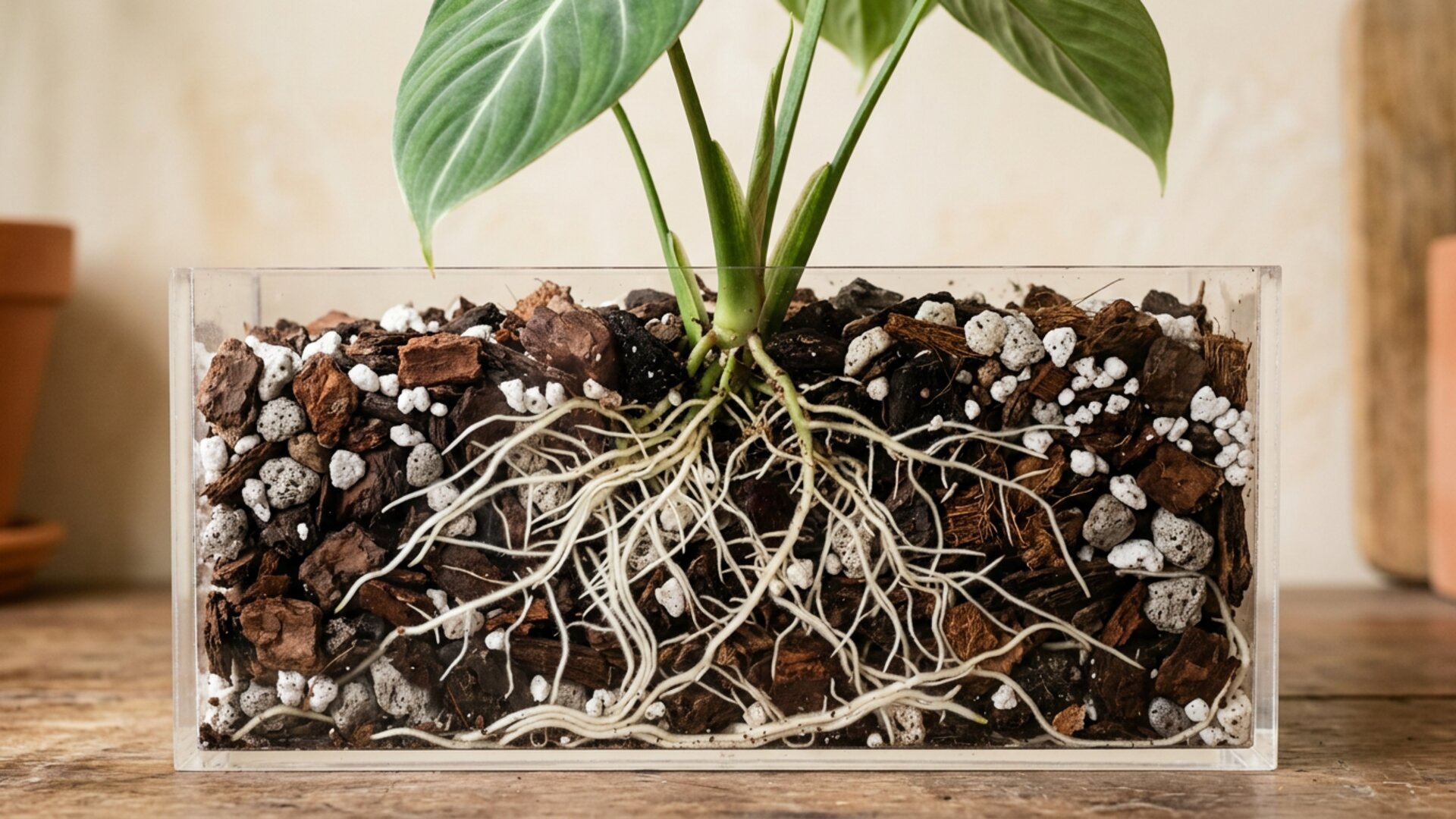
Begonias aren't aroids. Don't use a chunky bark mix. Maculata wants richer, finer, organic substrate that still drains fast. Here's what works:
- 50% quality coir-based potting mix
- 20% perlite or pumice
- 15% fine orchid bark or fine fir bark
- 10% worm castings
- 5% horticultural charcoal
Keep her slightly root-bound. Begonias flower better snug, and oversized pots hold too much water between waterings. Size up only when roots circle the drainage hole.
Temperature & Drafts
Keep her between 65-80°F (18-27°C). A night or two in the high 50s is fine. Sustained cold below 55°F (13°C) kills leaves. Winter window drafts scorch everything they touch.
Heat vents are worse. They pull humidity and crisp the margins overnight.
Pinch Her, or She Gets Leggy
This is the step most people skip. Maculata is a cane begonia. Left alone, she builds one or two tall stems that eventually snap.
Pinch the tip when a cane gets tall. The plant branches below, you get density, and every cut is a propagation. Once a year, cut an old cane back hard (down to two or three nodes) and let it rebuild from the base. She fills in denser each cycle.
Reading Maculata's Moods
- Yellowing lower leaves, mushy stem base — overwatering. Let her dry out and check the root ball.
- Crispy brown leaf margins — air's too dry or heat is on her. Move her or add humidity.
- Polka dots fading to plain green — not enough light. Move her closer to the window.
- Tall bare cane with leaves only at the top — she needed pinching months ago. Cut her back hard, she'll bounce.
- White powdery dust on leaves — powdery mildew. Pull the affected leaves, improve airflow, and spray with a 1:9 milk-to-water solution (Bettiol 1999, Crop Protection 18: 489–492) or a potassium bicarbonate fungicide. Note: powdery mildew thrives in warm, dry conditions, so dropping humidity isn't the right move — increase airflow instead (UC IPM Pest Notes — Powdery Mildew on Ornamentals).
- Clusters of buds that drop before opening — bud blast from a temperature swing or sudden dry air. Stabilize conditions and she'll try again.
Propagation: Stem Cuttings, Almost Unfair
Take a four-to-six-inch cutting just below a node. Strip the lower leaves. Water jar or damp substrate. Bright indirect light, 70-75°F (21-24°C). Roots show in two to three weeks.
Every pinch you do for shape is a propagation waiting to happen. This is a plant that wants to be shared.
A note for pet households: begonias are toxic to dogs, cats, and horses — they contain soluble calcium oxalates that cause oral irritation, drooling, and vomiting if chewed (ASPCA). The most toxic parts are the underground tubers and rhizomes.
The Takeaway
Maculata isn't hard. She's showy. Bright indirect light, a finer mix than you'd use for aroids, moving air. Pinch before she gets leggy. Water when the top inch dries, never on the leaves.
Do that, and every pinch becomes a new plant. Share the cuttings. That's half the point of growing her.
ASPCA Animal Poison Control. (n.d.). Begonia. American Society for the Prevention of Cruelty to Animals. https://www.aspca.org/pet-care/animal-poison-control/toxic-and-non-toxic-plants/begonia
Bettiol, W. (1999). Effectiveness of cow's milk against zucchini squash powdery mildew (Sphaerotheca fuliginea) in greenhouse conditions. Crop Protection, 18(7), 489–492.
Cornell University Department of Horticulture. (n.d.). Begonia disease management. Cornell Greenhouse Horticulture. https://greenhouse.cornell.edu/pests-diseases/diseases-of-specific-crops/begonia/
Plants of the World Online. (n.d.). Begonia maculata. Royal Botanic Gardens, Kew. https://powo.science.kew.org/taxon/urn:lsid:ipni.org:names:105130-1
UC Statewide IPM Program. (n.d.). Pest notes: Powdery mildew on ornamentals. University of California Agriculture and Natural Resources. https://ipm.ucanr.edu/home-and-landscape/powdery-mildew-on-ornamentals/pest-notes/