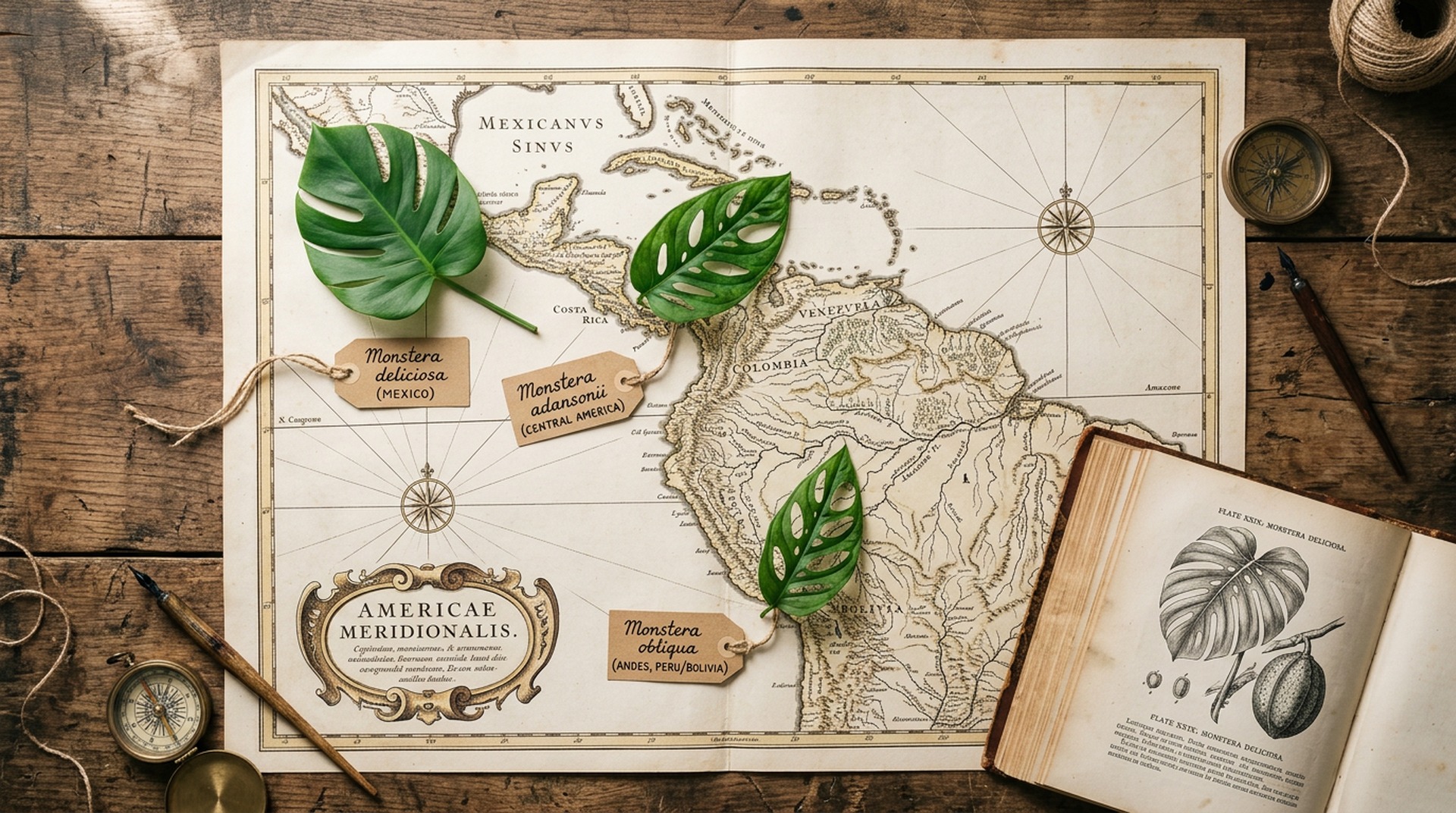
Every Monstera you have ever owned is a New World plant. Mexico to Bolivia, Costa Rican cloud forest to Amazonian lowland, with a center of gravity in two small Central American countries. The geography is half the care manual.
Why the Map Matters
It's easy to forget that Monstera is a place before it's a plant. The shape on the windowsill in your living room is a snapshot of a much larger life: a species that evolved over several million years in a specific kind of forest, in a specific band of latitude, under a specific set of climates that almost no apartment can fully reproduce. Knowing where it came from won't change the watering can you use. It will change what you're trying to do with it.
This essay walks the Monstera map. Where the genus lives in the wild, what conditions define its native range, why it never reached Africa or Asia under its own power, and what your apartment is approximating when it works. The point isn't trivia. It's that almost every care decision becomes obvious once you know the climate the plant evolved in.
The Range, in Plain Terms
Monstera is a strictly Neotropical genus. Its native range runs from southern Mexico through Central America, across the Caribbean, and down through the northern half of South America to roughly Bolivia and central Brazil. Per Plants of the World Online, accepted Monstera species number around fifty, though the count keeps moving as new species are described, especially from the Andes.
Within that broad range the genus isn't evenly distributed. Two regions concentrate most of the diversity:
- Costa Rica and Panama. The Mesoamerican wet-forest belt, especially the Atlantic slope of the Talamanca cordillera, is the single richest area for Monstera species in the world. Madison's 1977 revision treated this as the center of generic diversity, and subsequent fieldwork hasn't changed that picture. M. dubia, M. obliqua, M. siltepecana, M. epipremnoides, M. tuberculata, and a long tail of less-known species all overlap here.
- The northern Andes. Colombia, Ecuador, and northern Peru host a second center, especially at mid-elevation cloud forests between roughly 2,600 and 5,900 ft (800 and 1,800 m). Many of the recently described species, including segregates that used to be lumped under broad names like M. adansonii, came out of this region in the last two decades.
South of the Andean center, diversity drops off. The Amazon basin proper has Monstera, but fewer species, and they tend to be widespread types like M. obliqua sensu lato (the broadly-defined species complex, covering most of South America) rather than narrow endemics (species restricted to a single mountain or valley). The southern edge of the genus reaches Bolivia and the Atlantic forest of southeastern Brazil but doesn't continue further into the subtropics.
North of the natural range, M. deliciosa reaches its native limit in Veracruz, Mexico. It does not occur naturally in the United States, and the houseplant boom is the only reason it now exists everywhere.
Why There Are No African or Asian Monstera
This is where the disambiguation gets useful, because half the plants sold as "Monstera" online aren't Monstera at all.
The Araceae family is global, with major lineages in both the New and Old World tropics. But within Araceae, the climbing aroid lineages diverged a long time ago, and the genus Monstera ended up confined to the Neotropics. Its sister genera Rhaphidophora and Epipremnum ended up on the other side of the planet, primarily in tropical Asia, Indonesia, and the Pacific. The split is old enough that the morphological convergence is striking but the genetics are clear: a Rhaphidophora is more closely related to a pothos than to a Monstera, even when its leaves look like a Monstera adansonii. That's a story we'll tell in detail in a forthcoming Cousin Imposters entry, but it matters here because it bounds the map. If a plant marketed as Monstera was wild-collected anywhere in Africa, Asia, or Australasia, it isn't a Monstera. The genus is New World by hard biogeographical fact.
The practical consequence: when a plant care article tells you Monstera "comes from the rainforests of Southeast Asia," the article is wrong. That's a Rhaphidophora detail. Different genus, sometimes different climate, often different care.
The Cloud Forest Story
Costa Rica and Panama deserve their own section because the cloud-forest habitat they harbor is the closest thing to a Monstera reference environment that exists in the wild.
Cloud forest is a specific kind of tropical montane forest that sits in the elevation band where moisture-laden air rises off the Caribbean or Pacific lowlands, cools, and forms persistent cloud cover. Roughly 4,000 to 8,200 ft (1,200 to 2,500 m) in elevation, with daytime temperatures in the 60s and 70s Fahrenheit (about 15–25 °C), nighttime temperatures rarely below the mid-50s, and relative humidity that lives above 85% almost every day of the year. The canopy is dense but broken, and the understory receives a constant drift of fog through the foliage. Every horizontal surface, from tree trunks to fallen logs to its own branches, is colonized by epiphytes (plants that grow on other plants for structural support, without drawing nutrients from them) and hemiepiphytes (plants that begin life on the ground and later climb up to live in the canopy, or vice versa).
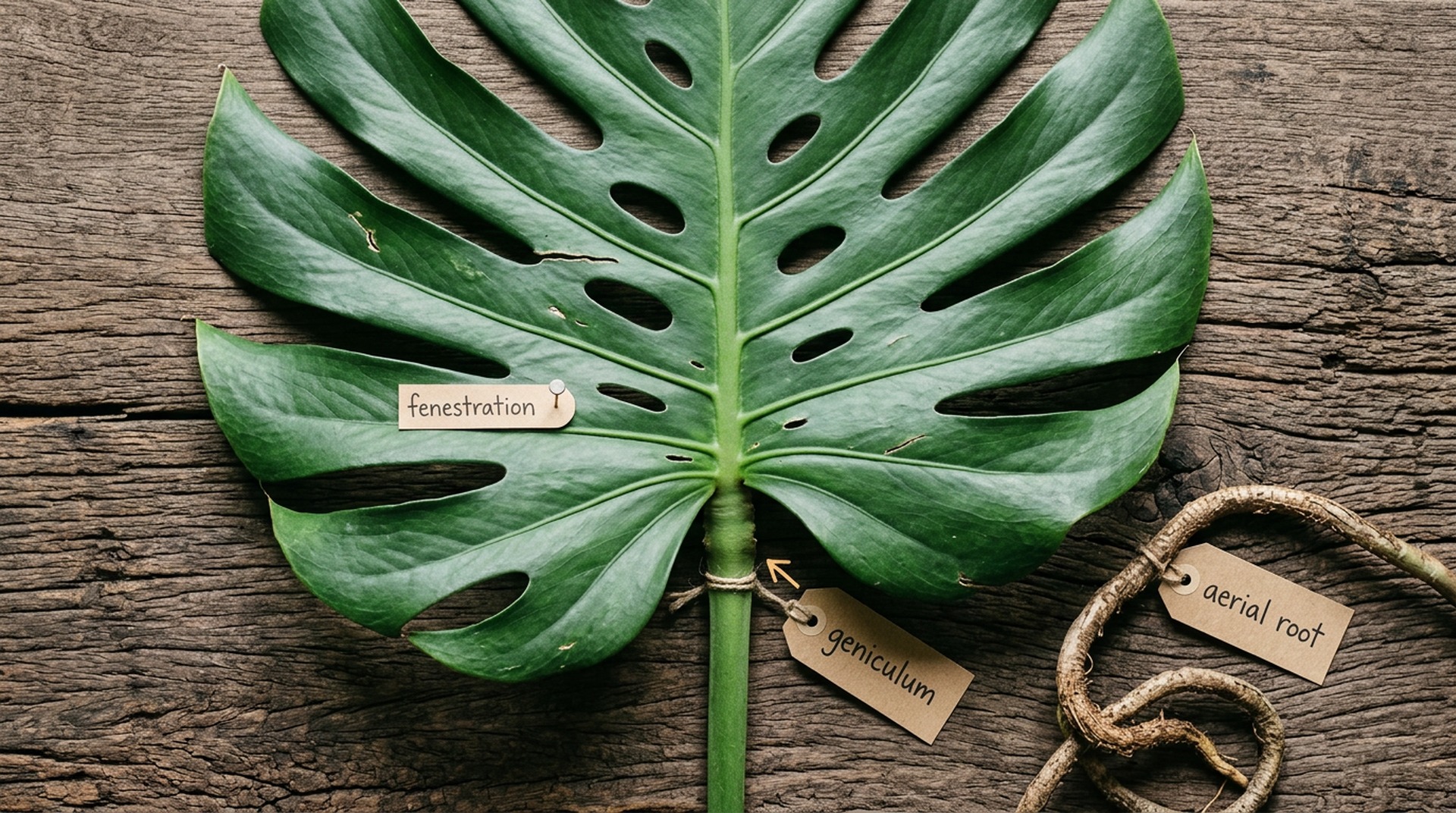
That's the world a Monstera grew up in. The roots evolved to climb wet bark covered in moss and bromeliads. The aerial roots evolved to feed on the constant rain of leaf litter and dripping moisture down the host trunk. The fenestrations evolved to chase sunflecks that punch through a broken canopy in brief, intense pulses. The geniculum evolved to reorient the leaf as the light angle shifted across the day.
Almost nothing about an apartment matches this. Indoor air at 40% humidity is a desert by the standards of a Monticeño cloud forest. A south-facing window in winter is brighter and more directional than the dappled, fog-diffused light the plant evolved under. Forced-air heat dries the air further. The plant tolerates the conditions because Monstera is, in cultivation, the survivor genus among aroids. It does not thrive on them the way it would on the side of a guarumo tree in San Vito de Coto Brus.
The Andean Question
The other major diversity center is in the northern Andes, and it complicates the picture in a useful way.
The Mesoamerican Monstera are mostly lowland to mid-elevation, warm-temperate, and fast-growing. The Andean Monstera tend to be slower, smaller, often more variable, and adapted to a cooler and mistier environment that's stratified more sharply by elevation. M. adansonii as currently understood is actually a complex of species, several of them Andean, and the population genetics suggest at least four or five distinct lineages going by that name in cultivation. Recent revisions by Croat and others continue to peel new species off the adansonii aggregate.
What this means for a grower: when you buy a Monstera adansonii, you may be buying any of several genetically distinct plants. The leaf shape, the growth rate, and the cold tolerance can all differ depending on which population the cutting came from. The "Brazilian form" and the "round form" and the "narrow form" sold in nurseries are real morphological differences, often tied to different natural populations or, in some cases, different species under the same trade name.
The Andean species also do something the lowland species mostly don't: they tolerate cool nights. A cloud forest at 5,900 ft (1,800 m) drops into the low 50s °F overnight, sometimes the high 40s in winter. Lowland species hate that. Andean species shrug. If you've ever wondered why your adansonii sailed through a cold snap that nearly killed your deliciosa, the answer might be that you have an Andean clone.
Hawaii, Florida, and the California Edge Case
Monstera has been introduced to almost every tropical and subtropical country in the world as an ornamental, and in a few of those it has gone feral.
Hawaii is the cleanest example. M. deliciosa is naturalized across the wet windward slopes of several of the main islands, especially Hawaii Island and Kauai. It climbs ʻōhiʻa (Metrosideros polymorpha, the dominant native Hawaiian canopy tree) and koa (Acacia koa, the endemic Hawaiian acacia), fruits readily, and recruits new seedlings into intact forest. The Hawaii Invasive Species Council and local conservation groups treat it as a moderate-tier invasive: established and spreading, and in some areas displacing native epiphyte communities outright. It's not the worst weed in the islands, but it's a real one.
Florida has scattered naturalized populations in the southern peninsula, mostly M. deliciosa escaped from gardens in Miami-Dade and Monroe counties. The University of Florida lists it as a Category II invasive in the Florida Exotic Pest Plant Council framework, meaning it's spreading but hasn't yet been documented to disrupt native plant communities at a measurable scale.
California is the edge case. M. deliciosa can survive outdoors in the sheltered, frost-free pockets of coastal California from roughly San Diego to the eastern Bay Area, and there are old residential specimens climbing tall on garden walls in San Marino, Santa Barbara, and the Berkeley flats. None of those are reproducing self-sufficiently. They flower and even occasionally fruit, but the seedlings don't establish outside of irrigated gardens. California is the latitudinal edge: warm enough to survive, dry enough that the genus can't naturalize.
Practical consequence: if you live somewhere with a microclimate that hits these conditions (Bay Area peninsula, coastal Southern California, the Florida Keys, Hawaii anywhere wet), you can grow Monstera outdoors and it will surprise you with how big it gets. Outside those microclimates, you're keeping a tropical understory plant in a temperate apartment, and the rules are different.
My Thai Constellation lives indoors year-round because Santa Clara County is right on the edge of where M. deliciosa survives unaided, and "survives" is not the same as "thrives." A 38 °F night in January will not kill a mature plant on a sheltered patio, but it will set growth back by weeks, and the next flush of leaves will come in smaller. The math just doesn't work for any of the more sensitive species. I'd rather run the air-conditioning a few extra weeks in summer than gamble a cold snap.
What Your Apartment Is Imitating
Indoor cultivation is, at its core, an attempt to approximate a small slice of a Costa Rican cloud forest. Some slices are easier to copy than others.
Temperature is the cheap one. Most apartments live in the 65–75 °F range, which is within tolerance for almost every Monstera species. The plants don't need warmth so much as they need the absence of cold. A consistent 68 is better than an oscillating 75-day / 58-night, even though the mean is the same. Stable temperature is a free care upgrade most growers overlook.
Light is the part most growers get wrong. The cloud-forest light environment is bright but diffused, with the brightness coming from a broken canopy and the diffusion coming from fog and overcast. The closest indoor analog is a north-facing or east-facing window with sheer curtains, or a south window six to eight feet away from the glass. Direct unfiltered sun at a south window will scorch the leaves of any shade-adapted Monstera (obliqua, siltepecana, juvenile deliciosa) within days. Adult deliciosa in the canopy form tolerates more, but even it doesn't want unfiltered desert sun.
Humidity is the hardest. Cloud forest humidity is 80–95% year-round; California apartment humidity in winter is 25–35%. Closing that gap is the entire game with sensitive species. Group plantings, pebble trays, and a single dedicated room humidifier do more than any other piece of equipment you can buy. Ignore the species-specific "humidity needs" tables that exist online. The number every Monstera wants is "more than your apartment has."
Substrate is the cheap fix. Cloud-forest soils are leaf litter, decomposing bark, moss, and air, mixed in roughly equal parts on top of mineral subsoil. A chunky aroid mineral mix (Fluval Stratum, perlite, bark, charcoal, some Akadama or pumice) approximates this surprisingly well. See the Aroid Mineral Mix entry for the recipe.
Climbing surface is the substitute for a tree. Without one, the plant stays in juvenile mode forever. With one, it transitions. The choice of moss pole versus coir pole versus PVC versus wood is less important than the fact that the pole exists.
The Takeaway
Monstera is a Neotropical genus, concentrated in Costa Rica and Panama and the northern Andes, restricted to tropical wet forests, and entirely absent from the Old World in the wild. Everything the plant does in your home is a holdover from the cloud forest it evolved in. The aerial roots are looking for bark. The fenestrations are looking for sunflecks. The leaves are calibrated for 85% humidity and dappled, fog-softened light.
You can't fully reproduce the cloud forest in an apartment. You can match enough of it that the plant prospers, and the closer you get, the better the plant looks. Once you can see your apartment as a partial simulation of a place rather than a "growing environment" in the abstract, the decisions about light, humidity, and substrate stop being preferences and start being precision adjustments.
Madison, M. (1977). A revision of Monstera (Araceae). Contributions from the Gray Herbarium of Harvard University, 207, 3–100.
Croat, T. B. (1998). History and current status of systematic research with Araceae. Aroideana, 21, 26–145.
Mayo, S. J., Bogner, J., & Boyce, P. C. (1997). The Genera of Araceae. Royal Botanic Gardens, Kew.
Cabrera, L. I., Salazar, G. A., Chase, M. W., Mayo, S. J., Bogner, J., & Dávila, P. (2008). Phylogenetic relationships of aroids and duckweeds (Araceae) inferred from coding and noncoding plastid DNA. American Journal of Botany, 95(9), 1153–1165. https://doi.org/10.3732/ajb.0800073
Plants of the World Online. Monstera Adans. Royal Botanic Gardens, Kew. https://powo.science.kew.org/
Hawaii Invasive Species Council. Established invasive plants in Hawaii. State of Hawaii Department of Land and Natural Resources. https://dlnr.hawaii.gov/hisc/
Florida Exotic Pest Plant Council. (2019). List of invasive plant species. https://www.fleppc.org/list/list.htm